Sunday, January 18, 2009

Fernando Verdasco in 2009-- Rise or Fall?

Fernando Verdasco, Davis Cup hero against Argentina.

Fernando Verdasco ended 2008 on a high. He had lifted his ATP Tour ranking to 11th in the world, including a title in Umag (Croatia), and he beat Argentine Jose Acasuso in the last rubber of the Davis Cup Final to secure victory for Spain. Before the match, Verdasco had told Spain's Davis Cup coach Emilio Sanchez that he wanted to be a hero, and he delivered.

According to Deuce Magazine, Verdasco then did something that was for him uncharacteristic. Leaving his family behind in Spain, Verdasco flew to Las Vegas in December to work with Gil Reyes, the trainer who played a key role in making Andre Agassi a great tennis champion. Anyone who has seen Verdasco's sculpted body, and many have had the chance since he agreed to pose nude for the UK version of Cosmopolitan in 2008, might find it hard to believe that he needed to increase his fitness, but Verdasco wanted to start strong in 2009.

So far, it seems his plan is working. He made it to the final of the tournament in Brisbane, two weeks before the start of the Australian Open and is seeded 14th at the Open. Unfortunately, he will find himself in the quarter of the draw anchored by world number 4 Andy Murray, who turned into a powerhouse in 2008, winning 5 titles and making it to his first Grand Slam final at the U.S. Open, where he lost to Roger Federer. Murray has already started 2009 with a roar, winning the title in Doha by beating Roger Federer in the semifinal and Andy Roddick in the final. Also in Verdasco's quarter are last year's Australian Open finalist Jo-Wilfried Tsonga, seeded 5th, 9th seeded James Blake, and 22nd seed Radek Stepanek, to whom Verdasco lost in the final at Brisbane.

Fernando Verdasco would have had a tough row to hoe at the Australian Open in any case, because his record there is a miserable 4-5, and he has lost in the second round the past three years. This year, if he makes it to the third round, he will be facing his Brisbane nemesis, Radek Stepanek. If he gets past Stepanek, he will have to face Andy Murray. If he were to beat Murray, he would have his countryman, number 1-ranked Rafael Nadal in his future. Frankly, his prospects are not good, but even making it past the third round would be a victory of sorts and a contribution to the fast start he is hoping for in 2009.

After the Australian Open comes the early clay court season in South America, where Verdasco has a chance to shine, followed by two Masters Series tournaments in the USA, then the important European clay court season leading to Roland Garros. If Fernando Verdasco wants to rise above his 2008 11th place ranking, he needs to keep his momentum going and become better known for celebrating victories than posing without his clothes.

Friday, January 16, 2009

A la famiglia! To the family! (With caveats)

Barack Obama and his family on November 4, 2008. Mrs. Obama's mother is seated to her right.

Right now there is a lot of speculation about how the Obama family unit will shape up when they finally occupy the White House on January 20, 2009. There is, of course, the momentous decision of what puppy to buy for the Obamas' two daughters, Sasha and Malia. Occupying nearly as much attention, however, is the question of whether Mrs. Obama's mother, Marian Robinson, will move into the White House, as well. At this point, it looks as if she will, although she isn't sure how long she will stay before returning to her own home in Chicago. But as of January 20, 2009, the First Family in the White House will be a multigenerational family, which reflects a growing trend in the United States.

When I was a kid, my Aunt Mary and her family lived in the same house as my maternal grandmother at 102 East Tenth Street, in Oswego, New York. My great grandmother, my great-aunt, and one of my great uncles lived next door on one side on the corner of East Tenth and Schuyler Streets, my grandmother's sister and two of her children lived next door on the other side on East Tenth Street, and one of my grandmother's brothers and his family lived directly behind her on Schuyler Street. My paternal grandmother lived on her own on Willow Street in Syracuse, but her home was the upstairs apartment in a house owned and occupied by one of her daughters and her family.

In those days, multigenerational families were common. It seemed as if most of the people I knew had a least one relative beyond the nuclear family living with them, although few of them lived in anything like the compound occupied by the Familos (of which my grandmother was a daughter) in the area of East Tenth and Schuyler Streets in Oswego. Between my grandmother's family and my Uncle Ed's (Aunt Mary's husband) family, nearly everyone in the neighborhood was a relative, and everyone was in and out of 102 East Tenth Street all day every day. This was pretty hard on my aunt, who heard an almost constant litany of "Mary, put on a pot of coffee!" or "Mary, Uncle Allie's staying for lunch!" or "Mary, your brother Pete and his family are on their way from Ohio!" She must have thought she was running a hotel in those days. And later, when my grandmother was ill with Parkinson's disease and housebound, Aunt Mary must have wondered why the relatives always showed up at mealtimes and almost never when they could have kept my grandmother company while my aunt went shopping or had a few hours out with her husband.

Over time, the phenomenon of the multigenerational family living under one roof faded away for the middle class. Children grew up and moved away from the old neighborhood, maybe even out of state, and their children did the same. And so-called "empty-nesters" often moved away, too, to retirement homes in Florida or Arizona. Family ties were stretched thin, and often people didn't see each other except at holdays or, unfortunately, funerals. Now the situation is changing again.

According to the 2000 Census, nearly four million (3.9 million) American households consist of three or more generations living together. In some cases, these are ethnic families, many of them Hispanic or Asian, in which multigenerational living arrangements are traditional. In some cases, they are families in which grown children have landed back in the parental household because of economic or marital problems (so-called "boomerang" children), or families in which the children grow up but don't leave the home. And some sad cases involve grandparents caring for their grandchildren because their own children are incapable or incarcerated. Now, however, we are seeing a new trend, families with children in which both parents have careers and at least one in-law lives with them.

Today, the New York Times ran an article suggesting (more subtly than I am stating it) that the new "in" accessory for two-career families is the live-in grandparent, who can share in the childcare, cooking and cleaning duties. According to the Times, this has required an adjustment in power relationships in order for the generations to live comfortably together in the modern world. Today, says the Times, mom is a working woman's best friend, and people aren't afraid to say so.

I think that's great. However, my concern is that the folks who are finding mom to be their best friend now must realize that someday their parents are going to cease being caregivers and need care themselves. You can't just say, "Gee, thanks for all you did. It's time to go to assisted living now." If Grandma is really a part of the family, then everyone needs to save up financially and emotionally for the next stage and accept it graciously. I am unmarried and childless. My life companion (his life, obviously) is a 6-pound Yorkshire terrier. My mother lived with me for the last five years of her life, and my only regret is that maybe I didn't do everything I could have to provide her with the best possible life, although I always found great satisfaction in Mom's reports that the other ladies in her bridge club envied her. Those years were not always easy for me, but I wouldn't trade them for anything in the world.

So, here's to the family, but don't forget about future responsibilities, folks, because they will be there before you know it, and you'd better be ready to step up.

Monday, January 5, 2009

Do you trust me? I wouldn't!

You may think you know who's behind the mask, but do you really?

There's an awful lot of information being offered on blogs these days. No matter what topic you choose, somebody, and probably more than just one somebody, is blogging about it. If you do a Google search about nearly anything, blog entries pop up right away, and sometimes it takes a while to realize that what you have found is posted on a blog because many of them are formatted to look very professional and authoritative. The question is, who writes all those blogs, and why should I, or you, pay attention to them?

Considering that this is a blog post, you must think I have a lot of nerve writing this, but somewhere along the line I was trained as an academic researcher, and I spend a good deal of my time nagging undergraduates about the quality of the sources they use in their papers. I should say immediately that I am not talking about online academic journals that publish refereed articles in a non-print, electronic format. With the sky-high cost of publishing anything these days, putting your academic journal online seems like a good move. (It also cuts down on the number of those cute little article reprints that your colleagues press upon you. Sure they're justifiably proud of having gotten published, but what are you supposed to do with those things? How fortunate to have a shredder at home.) No, what I am talking about are the blogs written by folks like me, or folks who know a great deal more than I do, or folks who just want to see their words "in print," whether they know anything or not.

For many of us, and for me in particular, blogging is just a matter of putting your thoughts out into the ether and hoping that someone who is interested will read them and maybe even respond. And even if readers don't respond, there is still a great deal of satisfaction, not to mention real benefit, in getting your thoughts in order and expressing yourself in a formal manner. Whether one expects a response or not, once the blog is published, it will eventually find its way onto the search engines, and people will find it when they search the topic about which you have written. Knowing that puts a burden of responsibility on the blogger to be truthful and accurate, even if one is under no requirement at all to be fair and balanced. The information literacy tutorial provided by our college library gives four criteria for evaluating the quality of materials. They should be useful/relevant, timely, appropriate, and authoritative. The sticking point with blogs is obvious: How do you know that the writer of the blog you are reading has any credentials whatever? Anybody can write a blog. That's the point. Ever since I have written entries for encyclopedias, I have become very sceptical about credentials. If they'll let me write for an encyclopedia, God only knows who's writing blogs.

It pays, therefore, to be a very critical reader these days, because you have very little idea whether the author whose words you are reading knows anything at all. Fortunately, it's not always overpoweringly difficult to check the accuracy of what you are reading. For example, if I tell you that corvine means "of or pertaining to crows," you can look it up and see if I am right. I may even be obliging enough to give you a source for my definition. But once you get past the basic things like whether I know the meaning of the words I use, what then? And that isn't as basic as it sounds, because I have found that many of my students use words that don't mean what they think they mean. I won't burden you with examples, but it's all too true.

Some blogs assume a cloak of authority by their association with institutions that we trust, more or less anyway. So if you read blogs associated with the New York Times or CNN, for example, you may think that someone who knows something is monitoring what is written on those blogs. Maybe that's true, although I don't know that it's true. It's a jungle out there, and you have to be careful. Just remember, I warned you.

Saturday, January 3, 2009

What are the Seven Wonders of the Ancient World?

The map at the left shows the close proximity to one another of the Seven Wonders of the Ancient World.

Whenever conversation flags, I am apt to ask my older sister, Sue, what are the seven wonders of the ancient world? Sometimes we manage to name them all from memory, and sometimes we don't. If we name the seven wonders correctly, we generally progress to the names of the Nine Muses, which we never remember in total. Unless we're in a really masochistic frame of mind, that's the end of our quiz.

The Seven Wonders of the Ancient World were prominent examples of what is called monumental architecture. They were tombs, temples, palace gardens, victory statues, and an enormous lighthouse, whose light could reputedly be seen 50 miles away. One thing they all had in common was that they were big. Another thing is that they were all built around the Mediterranean basin, from Greece to Turkey to Egypt, and the Greeks had a hand in nearly all of them, directly or indirectly. There have been various lists of the so-called seven wonders of the world, including those of Herodotus and Philo of Byzantium. The list of monuments below is the same list given by Antipater of Sidon. By the end of the Middle Ages, all of the listed structures were gone except the Great Pyramid, which survives to this day.

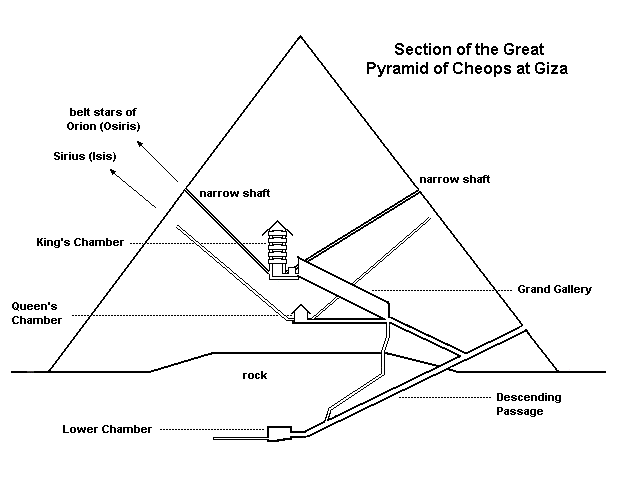
The Great Pyramid of Giza (ca. 2560 B.C.) This enormous structure, the tomb of the Pharaoh Khufu (Cheops), was built on the plateau of Giza near Cairo at a time before the wheel was invented and without iron tools. The base of the pyramid is a perfect square, and its triangular walls converge to form a point. It was built of enormous limestone blocks and deep inside is the burial chamber of Khufu. The Great Pyramid is still in existence today, although it was stripped of its smooth facing of polished limestone slabs, which were later reused for other building projects. The controversial glass pyramid in front of the Louvre, designed by I.M. Pei, is modeled on the Great Pyramid of Giza.

The Hanging Gardens of Babylon (ca. 600 B.C.) There is a fair amount of controversy about whether the Hanging Gardens of Babylon ever existed at all. They were supposed to be incredible gardens built on the heights of his palace in Babylon, in ancient Mesopotamia, by King Nebuchadnezzar II. The stories say that Nebuchadnezzar had the gardens contructed as a wedding gift for his wife, Amytis of Media. If the gardens existed, they were probably not as large and lush as they are usually represented. Situated in the desert environment of what is now Iraq, it would have been extremely difficult to get water up to them. According to accounts, the Hanging Gardens of Babylon were destroyed by an earthquake about a century after their construction.

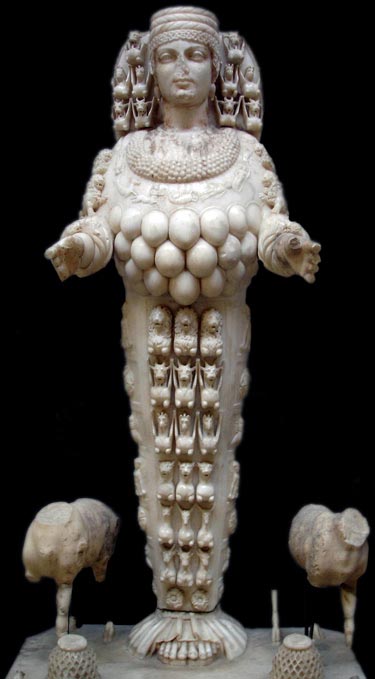
The Temple of Artemis at Ephesus (ca. 550 B.C. ) Artemis was, among other things, the Greek goddess of fertility. She is sometimes depicted as having many breasts. Ephesus (now in modern Turkey) was the site of a fertility cult associated with Artemis. There an enormous temple to Artemis was contructed. Although only a few ruins remain, this temple was thought to look much like the Parthenon in Athens, only much bigger. The temple was destroyed by arson in 350 B.C. This was possible because the marble temple had a wooden interior framework. When that burned through, the roof collapsed.

The Statue of Zeus at Olympia (ca. 432 B.C.) This seated representation of the chief of the gods, Zeus, was designed and executed by the sculptor Phidias for the temple of Zeus at Olympia, the site of the Olympic Games. It was made of ivory and allegedly stood over 40 feet high. The statue was destroyed. It either perished in the burning of the temple of Zeus in 425 A.D. or was taken to a palace in Constantinople as war booty and subsequently lost in a fire in 475 A.D. No one knows exactly what the statue looked like, but there have been many representations of it over the centuries. The statue of Abraham Lincoln in the Lincoln Memorial in Washington, D.C. is modeled on the statue of Zeus at Olympia.

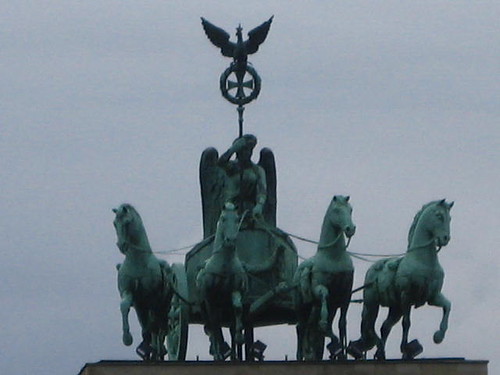
The Tomb of Mausolus (Mausoleum) at Halicarnassus (ca. 350 B.C.) was the monumental tomb of the Persian satrap Mausolus and his wife Artemisia. The word mausoleum is derived from this structure. Mausolus ruled a powerful fortified city which is now Bodrum, in Turkey. Inspired by Khufu's pyramid, Mausolus had a huge tomb constructed for himself. This enormous structure, designed by a Greek architect, embodied a mixture of styles and was decorated with many statues, including a huge chariot drawn by four horses that stood at the peak of the tomb's roof. Today, a similar statute of a chariot stands atop the Brandenburg Gate in Berlin. Mausolus died before the tomb was completed, but his wife finished it after his death, and both of them were buried there. The tomb was destroyed by a series of earthquakes ca. 1400 A.D. Many existing buildings have been modeled on the Mausoleum at Halicarnassus, but they do not have the extensive exterior decoration. One example is the Masonic Temple in Washington, D.C.

The Colossus of Rhodes (ca. 280 B.C.) - Rhodes is a Greek island located in the Aegean sea not far from the coast of Turkey. After the breakup of the Greek empire following the death of Alexander the Great, Rhodes withstood a great siege and built a huge bronze image of the sun god, Helios, in the harbor of the city of Rhodes as a sign of its victory. This cast bronze statue was said to be more than 100 feet tall. The statue, known as the Colossus of Rhodes, was destroyed by an earthquake in 226 B.C. However, its ruins were a great tourist attraction for a long time therafter. A modern, but much more durable, version of the Colossus of Rhodes is the Statue of Liberty, which stands on an island in New York harbor. Designed by Auguste Bertholdi, the statue was erected in 1886. Its interior framework of steel was designed by French engineer Alexandre Gustave Eiffel, best known for the Eiffel Tower in Paris. With interior support much like the Eiffel Tower, the Statue of Liberty is much more stable than the Colossus of Rhodes, which collapsed only 56 years after its completion.

The Pharos of Alexandria (ca. 247 B.C.) Of all the seven wonders, this is the one that interests me the most, perhaps because it was the most practical one. The Pharos was an enormous lighthouse built in the harbor at Alexandria. It was reputed to be about 400 feet high. It was used as a navigational aid, but, of course, it was also a prominent symbol of the power of Alexandria. The Pharos was seriously damaged by earthquakes in the 14th century A.D., then the ruins were used to build a fortress (Fort Qaitbey) in 1480 A.D. Stones from the base of the Pharos are visible in the surviving fortress. Remnants of the Pharos have also been discovered on the sea bottom in the harbor of Alexandria. Since 1994, underwater archaelogists have been plotting, measuring, and weighing the underwater ruins of the Pharos, and some of the remnants have been recovered.

So now, if anyone asks you, you can list the Seven Wonders of the Ancient World.

Monday, December 15, 2008

Favorite Lieder (3): Robert Schumann "Schoene Fremde"


Dreamer (Ruins of the Oybin) by Caspar David Friedrich, ca. 1835 (The Hermitage, St. Petersburg, Russia)

My favorite song cycle is Robert Schumann's Liederkreis, op. 39 (1840). Liederkreis means "garland of songs," or a song collection. In this case, all the songs are settings of poems by the great Romantic poet Joseph von Eichendorff, and they form a kind of loose narrative of a wanderer's love and longing for his beloved and his homeland. The connections are of theme and mood, not strict storytelling. This collection of songs was written in 1840, during Schumann's "year of song," when he finally married his beloved Clara.

The op.39 Liederkreis is full of allusions to ancient times and ancient ruins, so it goes well with the paintings of Caspar David Friedrich (1774-1840). Friedrich painted many scenes in which classical, Germanic, or Christian ruins are the subject or the evocative background. The Dreamer (left) is a good example. "Schoene Fremde" is half dream, half vision, and the word trunken (literally "drunkenly") expresses the poet's rapture, which is wonderfully reflected in Schumann's music.

See and hear a very young Bryn Terfel sing "Schoene Fremde" with Malcolm Martineau at the piano.

Schöne Fremde* (Robert Schumann, 1810-1856)

Es rauschen die Wipfel und schauern,
Als machten zu dieser Stund
Um die halbversunkenen Mauern
Die alten Götter die Rund.

Hier hinter den Myrtenbäumen
In heimlich dämmernder Pracht,
Was sprichst du wirr wie in Träumen
Zu mir, phantastische Nacht?

Es funkeln auf mich alle Sterne
Mit glühendem Liebesblick,
Es redet trunken die Ferne
Wie vom künftigem, großem Glück.

[Joseph von Eichendorff (1788-1857)]

*German text with thanks to Emily Ezust from http://www.recmusic.org/lieder/get_text.html?TextId=5276.


In a Lovely Distant Land

The treetops sigh and tremble,
As if at this hour
The ancient gods circled
Around the half-buried walls.

Here amid the myrtle trees
In mysterious twilight splendor,
Why do you speak cryptically
as in a dream, wondrous night?

All the stars blaze at me
With the burning gaze of love,
Distant places speak ecstatically
Of great happiness to come.

Translation (c) 2008 by Celia Sgroi

Thursday, December 11, 2008

Good Car = Ugly Car?

The Nissan Cube. The Ugly Duckling that could?


In May of 2008, Nissan announced that it will market an all-electric car in the USA in 2010. It will be an emissions-free, environmentally-friendly car. It will also be small, which isn't surprising, because one assumes that the technology is not yet advanced enough to power a bigger car effectively. I understand that perfectly.

The car will also be ugly. Apparently, the design of choice is likely to be the Nissan Cube. This I will never understand. Why does a good car have to be ugly? Can't we have at least a spoonful of sugar to help the medicine go down?

I am told that younger, hipper car buyers like these square cars. I don't know about that, but I do see one or two models of the Honda Element in the parking lot at SUNY Oswego, where I work. They are bigger versions of the Nissan Cube pictured above, and they are butt-ugly, in my humble opinion. When you go to the Honda website, there is "young people's" music and they have colorful graphics that feature a skateboard, so obviously the car isn't aimed at old fogies like me. Thank God for that.

But I have two questions. First, in this lousy economy, with credit shrunken down to nothing, are there enough youngsters out there to buy these funky-looking cars? And second, why can't an old bag like me help the environment by buying an all-electric, environmentally-friendly Nissan that looks like my idea of a car? What I mean is, why can't there be one that looks like the Nissan Sentra, even if it is smaller? Yes, those kids are young and hip and all that, but I have money. Why not target me for a change?

Of course, there is another problem. In my part of the world, Oswego, NY, where it is winter for at least five months of the year, and where winter means lots of snow and ice, and where shrinking municipal budgets mean less plowing and sanding, a really small car doesn't look so good. I mean, you can save a lot of money on fuel and help reduce emissions if you leave your car in the garage all winter, but how feasible is that? Besides, I don't need a new car to help the environment in that way; I can just take the bus to work. Not a bad idea, but it won't help the auto industry.

Sunday, December 7, 2008

Comeuppances, and Not

Some notable things happened in the world of the rich and famous this week. Or at least, to be accurate, one involved the formerly rich and merely notorious.

O.J. Simpson, the former football great, who was acquitted in 1995 of the murders of his ex-wife and her boyfriend, was sentenced this week in Nevada to a minimum of 9 years and a maximum of 33 years in prison for armed robbery and kidnapping. Sunny von Buelow, whose husband Claus was tried for her attempted murder by insulin overdose in 1980 and after a conviction was eventually retried and acquitted, died at the age of 76, still in a coma after 28 years. And CBS Sunday Morning broadcast a story about the late Brooke Astor as promotion of a new book entitled Mrs. Astor Regrets, which tells the story of how, at more than 100 years of age, the wealthy socialite and philanthropist was allegedly swindled out of more than $60 million by her son and guardian, Tony Marshall.

In the case of O.J. Simpson, most people see his downward spiral in the years after his acquittal and his ultimate conviction and prison sentence for a Las Vegas hotel robbery as a final accounting for the murders that he committed and never paid for. The Simpson case was tawdry from start to finish, perhaps befitting a former ghetto kid who achieved fame and fortune for his football talent but never gave up his penchant for dubious friends and fast living. It is a sorry tale, but in the end the bad guy seems to have gotten his comeuppance.

As far as Claus von Buelow is concerned, the second husband of millionaire Martha (Sunny) Crawford, whose first marriage was to a prince, was convicted of attempted murder by giving his wife an overdose of insulin. Mrs. von Buelow was found comatose in the bathroom of their mansion in Newport, R.I. She never recovered. Von Buelow appealed and won a retrial, at which he was acquitted in 1985. One of his lawyers on the appeal, Alan Dershowitz, wrote a book about the case called Reversal of Fortune, which was later made into a film of the same name (1990) with Jeremy Irons playing Claus von Buelow. After much bitter family wrangling, von Buelow renounced any claim to his wife's $75-million estate in exchange for his daughter Cosima's, reinstatement in her grandmother's will. Today, Claus von Buelow is a society figure in London.

Tony Marshall is Brooke Astor's son by her first marriage, although he later took the surname of her second husband, Charles "Buddy" Marshall. He is the eldest of Brooke Astor's three children. Brooke Astor became immensely wealthy when she married her third husband, Vincent Astor, but did not blossom into the socialite and philanthropist she was known as until she was widowed. She administered the Astor Foundation and gave enormous amounts of money to many important New York City Institutions, such as the New York Public Library, the Bronx Zoo, and the Metropolitan Museum of Art.

Mrs. Astor had the good fortune, and later the curse, of living an unusually long life. In her later years and suffering from Alzheimer's disease, her son Tony was appointed to be her guardian. Some of her prominent friends, including Annette de la Renta and David Rockefeller, were concerned that she was not being properly cared for, and they persuaded her grandson, Philip Marshall, to bring a lawsuit against his father, Tony Marshall. What emerged was a sorry tale of negelect, exploitation, and probable larceny and fraud. Marshall still faces trial on a number of criminal charges, the most serious of which, grand larceny, carries a maximum penalty of 25 years in prison. Marshall is accused of inducing his ailing and demented mother to sign an alteration of her will that bequeathed $60 million, originally earmarked for her favorite charities, to him.

The court named Mrs. de la Renta to be Mrs. Astor's new guardian, and Brooke Astor lived out the rest of her days in the mansion on her estate in Briarcliff Manor, NY. She was 105 years old when she died in 2007. At the present time, Tony Marshall is free and living in New York City with his wife. However, he is in severe financial difficulties because of the legal fees arising from the charges against him and is embroiled in litigation with the charitable institutions that stand to benefit if the allegedly forged will of Brooke Astor is set aside.

The 84-year-old Tony Marshall had heart bypass surgery in 2008. Whether he will be around to be convicted of grand larceny and eleven other felony counts is anyone's guess. Considering that his mother lived to be 105, maybe he will. And maybe the man who bilked his demented mother's estate to finance theatre productions will get his comeuppance one day, but I wouldn't bet the farm on it.